
Nuestra Conexión Común con la Naturaleza
Ser una organización binacional
Nuestros colaboradores comparten un interés en el mundo natural, y nuestro personal trabaja arduamente para alinear nuestros esfuerzos y asegurar recursos naturales, comunidades vibrantes y economías enriquecedoras. Es algo que sentimos profundamente. Nuestras metas no se limitan a ningún país o comunidad, y de hecho, trascienden todo tipo de límites, al igual que las características de nuestro mundo natural que fluyen y migran a través de las fronteras sin pensar en la demografía, la economía o la política. Así es como lo describe Sonoran Institute: “Ojalá todos mis colegas pudieran vivir la experiencia de un día de trabajo en el campo en nuestros sitios de restauración, lo que podría incluir sembrar una semilla en el vivero, plantar un árbol y regarlo, y luego comer taquitos para el almuerzo bajo la sombra de un álamo, un sauce o un mezquite”. –Sandra Ortiz, coordinadora de restauración ribereña (Mexicali) “A menudo me sorprende la frecuencia con la que las consideraciones se detienen en la frontera. Por ejemplo, mira la mayoría de los mapas: si no supieras nada mejor, podrías suponer que los ríos y las cuencas se detienen en la línea de la frontera internacional”. –Amanda Smith, asociada de programas (Tucson) “Ser una organización binacional es un reflejo real del dicho de que el trabajo de conservación no conoce fronteras”. –John Shepard, director senior de programas (Tucson)
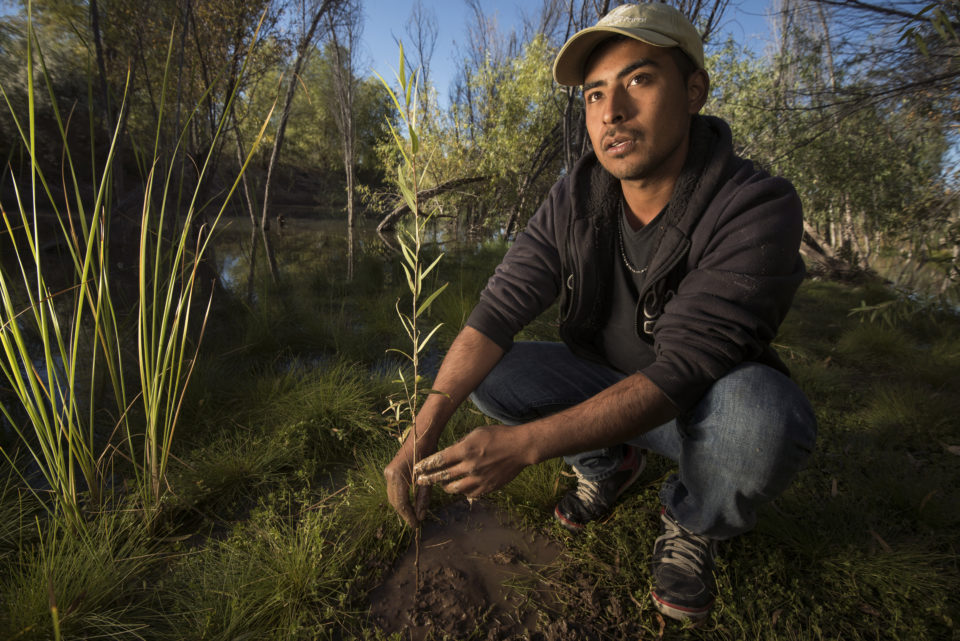
Daniel Chavez planting a willow seedling in Laguna Grande a restoration project run by the Sonoran Institute in the Colorado River Delta, Baja California, Mexico. ©Bill Hatcher, 2014
“The Phoenix metro region is one big hot sprawling suburb that attempts to swallow souls as the boredom and absurdity of summer scours at the roots that keep us here, but Phoenix ain’t all bad. As the region grows, there are more and more of us here fighting the good fight and championing nature and the services it provides. Thankfully, we have great access to amazing landscapes and ecosystems in which we can play, explore, discover, and recover so we can return to work ready for more.”
–Jeremy Stapleton, director of climate resilience (Phoenix)
“I would like everyone to be able to experience what we biologists are fortunate to experience: to be in a dark night full of stars in the estuary (seeing comets and the universe in question), waiting in the boat for the next zooplankton collection hearing the water and the wind, and the singing of the dolphins. Despite the pickets of flies, the cold of dawn, being wet and sleepless, I feel satisfaction in the field. I know that together with my team we are the only humans for kilometers performing actions that translate in numbers to justify more water for the Colorado River delta and better conditions for this wonderful estuarine habitat.”
–Elizabeth Díaz, estuarine ecological monitoring coordinator (Mexicali)
“I am extremely proud to work for a binational organization because it shows that we are all connected by the natural world and by working together to preserve it, everybody benefits. At the end of the day we are all just humans who ultimately rely on what our planet gives us.”
–Elise Christmon, development and finance coordinator (Tucson)
Esta es la parte 4 de 5 de una serie sobre ser una organización binacional. Lea las otras publicaciones:
- Una frontera no es una barrera (Introducción)
- Desafíos que conducen al crecimiento
- Desafíos que son persistentes
- Nuestra Conexión Común con la Naturaleza
- Orgullo, gratitud y generosidad
Por: Corinne Matesich, Gerente de Comunicaciones de Marketing